Showing posts with label Organization. Show all posts

August 20, 2019

Invest Up-Front

When my kids were seven and eight, I was becoming frustrated with how hard it was to complete the homeschool lessons I felt were appropriate and necessary to accomplish each day while subsequently babysitting two preschoolers and a baby. There was no question that I’d continue to homeschool, and my family needed the childcare income so I couldn’t give that up. I had to find a solution that worked within my circumstances.

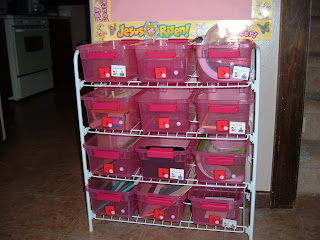
Shortly thereafter, I ran across an organizational tool, Sue Patrick’s Workbox System, that seemed promising. I bought the kit, poured over the instruction manual the day it arrived, and went shopping the next morning for supplies: portable shoe racks, plastic shoe boxes, colored card stock, laminating sheets (I already owned a laminator), and (lots and lots!) of Velcro. Watching me assemble the various pieces and then fill each box with a learning task piqued the girls’ curiosity; I used their interest to build anticipation about implementing the system.

But even though they’d observed me putting everything together, I didn’t expect them to automatically know what to do on our first day using it. Instead, I took a chunk of time to show them each part of the system, explaining its purpose, and then demonstrated how I expected them to move through the process. And during our first few days with it, I offered frequent reminders and encouragement. By the end of our first week, we were accomplishing twice as much bookwork in half the time as before! And it was such a hit that I developed a related system I called “Our Do-It Door” for chores and daily routines, and set up a box system for the preschoolers, who begged to be like “the big girls.”

Fast forward 10 years, and, though I’ve tweaked the system’s implementation to suit the girls’ needs as they’ve grown and matured, we still use its principles. In fact, taking time to set up a concrete organizational schema when they were young and coaching them in how to use it has been one of the most significant reasons they were able to become largely self-directed in their studies by the time they started high school.

We needed the tool – in this case, Sue Patrick’s brainchild – but that wasn’t enough. I also had to choose to invest time and energy into assembling it and then instructing and modeling its use. I had to listen to my kids and adapt when Sue’s suggestions didn’t quite meet our immediate needs, and I had to be patient as the girls learned how to complete the system’s steps. But it was all worth it, both in the short-term and over the long-run.

The same is true for any task – at any age – in which we need to teach and coach our kids. Investing up-front yields great benefit for them and for us.

CK

December 6, 2016

Strategically Winning December

My family thought I’d taken my well-earned nickname – “Rou-Tina” – a bit too far recently when I spent almost an entire day mapping out our December activities. My daughters and I take a break from most of our homeschool academic studies for most of the month, but I wanted to plan for the Advent devotionals we’ll be doing, and I needed to schedule daily practice time for their various instruments and make note of recitals and outside lesson times that occur throughout the month. There are also a few non-negotiable family traditions to incorporate, and I thought it would be fun to consider participating in some well-chosen Christmas-oriented community events.

Mapping it all out in table format allowed my picture-smart brain to see all the options, which was part of my goal. But it also helped me commit to another goal, which is to avoid holiday over-busyness. I know all too well – from personal experience as well as the regular laments of far too many friends – how easy it is to allow this time of year to become harried and hectic, the very antithesis of the beautiful, peaceful, reflective season it should be. I didn’t map things out to set a regimented, inflexible schedule – I fully anticipate that we’ll add some things and eliminate others as we go. But by laying out all the possible activities of which I’m already aware, I’ve been able to set a plan that I believe will allow us to actually enjoy the season.

Of course, every family has its own level of “tolerance” for a healthy amount of busyness. Thus, what would be crazy-busy for one family would represent the height of boredom for another, and what would constitute “just enough” activity for one would be chaos for another. I am planning for quiet, low-key weekday mornings and roughly two or three afternoon or evening activities of various sorts each week. I’ve avoided double scheduling – i.e., planning for two outside activities in one day – and, in fact, I’ve aimed for an activity no more than every other day because I know what my kids and I can handle. For each weekend – when my husband is home – I’ve listed one or two events to consider, and we’ll decide as a family when the time comes whether to do both, just one, or neither.

I realize that planning in December seems “unromantic” to some; in fact, there are those who appear to thrive on flying by the seat of their pants all year. But, realistically speaking, it seems that most of us too easily fall into the very stressful trap of non-stop activity because we haven’t taken time to set a course of action. I’d rather have my family tease me now and thank me later than find myself sniping at them because I’ve become over-extended. Strategy can win a war and it can “win December” too.

CK
*****
Photo Credit: Green Bay Botanical Garden

August 18, 2015

Are You with Me?

I’ve been a Christian for a long time. However, I’ve always struggled with maintaining a consistent “quiet time” – i.e., a personal, daily time spent with the Lord via the Scriptures and prayer. I do reasonably well with other areas of discipleship – regularly meeting in worship with fellow believers, serving the church, encouraging others – and I’ve even arranged my kids’ schedules to help them incorporate daily quiet time as a normative practice. But, still, the habit often eludes me.

Part of my struggle is surely latent perfectionism, a weed that sprouts up randomly in my various endeavors despite my ongoing efforts to root it out. Thus, I wrestle with the demon that says, “If you can’t spend three hours a day, don’t even bother starting,” or, “You’re just reading a few verses and praying? You’re not studying whole chapters in the original Greek? Pfft.”

Of course, some of my inconsistency has stemmed from genuine busy-ness doing good things. Before my kids were born, I was a classroom teacher, and I spent most of my free time every year modifying material to try meeting my students’ varied individual needs. Then when I became a full-time mom and my Irish-Twin girls were babies, my hands were very, very full. As they grew into toddlerhood, I began doing in-home childcare to supplement our income, so I regularly juggled the needs of half a dozen under-fives all day long. And then I started homeschooling, which has understandably required a great deal of time and effort.

But if truth be told, a big component of my struggle has simply been a failure to properly prioritize what’s most important. Even in my busiest seasons, I really have had enough time to quiet myself before God a little while each day. But, instead, I’ve too often chosen mornings with a dose of Matt Lauer or Fox & Friends, my kids’ afternoon rest time with Dr. Phil, and evenings with my Facebook friends.

If you’re like me, you take advantage of annual events and seasonal transitions to attempt change. So I’ve tried again since my family’s July vacation to get this quiet time thing on track. My girls are old enough to get breakfast themselves, so I’ve consciously chosen to use that time for God. I’ve consciously chosen to leave the TV and computer off until after I’ve prioritized time with Him. And I’ve consciously chosen to shoo away the pesky buzzing of Perfectionism, who tries to convince me that my “measly” thirty minutes “isn’t enough.” It’s a work in progress, but it’s working.


Do you struggle with me in this? If so, why not use this upcoming “back to school season” which – though often hectic – is a natural transitional time you might leverage to your advantage. First, decide which time-waster needs pruning. Then push Perfectionism to the curb and just start – even if it’s “just” a few verses and a brief devotional. Meeting our kids’ needs and serving others matters deeply, but we want to be authentic models of spiritual growth for our children, and we need daily bread to keep doing good works. Making daily time for God is what we need most of all. Are you with me in trying again to become consistent?

*****
Photo Credit: Amancay Maahs

CK

January 8, 2013

Worth It


I’m living in a new house.

I haven’t moved. But I took the week between Christmas and New Year’s to accomplish a task I’d pondered for months: deep cleaning and reorganizing my home from top to bottom.

I hadn’t necessarily planned to tackle the project just then, but the gift of a new computer motivated me to reconfigure my home office…which inspired me to clean out and de-junk the entire room…which gave me momentum to keep going until I’d reorganized virtually every space in the house. My husband cleaned up his home office, too, and we followed through on a long-promised bedroom switch for our daughters. So by New Year’s Eve a long line of large garbage bags awaited pickup on our curb and a huge pile of items to donate sat in our basement.


I can now easily locate anything I seek in any closet or cupboard. My girls can find all their art supplies and toys at a glance. My refrigerator isn’t growing any accidental science experiments. And I feel less materialistic because, though we still have much more “stuff” than most people around the world will acquire in a lifetime, I’ve actually gotten rid of most things we owned but never truly used. My home feels refreshed and new.


I don’t describe that to toot my own horn. In fact, I don’t resemble anyone’s image of “Susie Homemaker.” Before last week, I managed to make things presentable for company, but piles of embarrassing clutter lurked behind closed doors, and I hid the wretched state of my kitchen by firmly refusing my guests’ offers to help with meal prep. And I’m going to struggle to maintain a semblance of the newly streamlined look of the place.

But now, because I devoted the time and effort necessary to tackle my looming problem, I finally have hope that maintenance is possible. Now I pause to return things to their proper places instead of just leaving them for another day. And now I can see the merits and value of setting up a regular weekly cleaning schedule. 

The same can really be said for virtually any big task any of us faces.

Is your marriage on fragile footing? Do you struggle to communicate with a moody child? Are your finances in disarray? Are you dissatisfied in your job?

Each of those problems – and many others – can seem as insurmountable as climbing Mount Everest. And when a situation involves other people, we can still only tackle our side of the summit, trusting that our work might motivate other parties. But my house renewal project started with the first bag I stuffed with unnecessary papers and broken pens and pencils. And those who’ve actually scaled Mount Everest got there by taking an initial step.

We can begin new projects any time, but starting in January can be especially motivating for many. If that’s true for you, decide on one big task you feel called to tackle right now. Then take the first step today so you can build momentum toward eventually finishing the job.

My house and I can attest that it’s worth the effort.


CK

December 30, 2011

Tick-Tock, Tick-Tock

The minutes are ticking away. We’re just [hours] from the beginning of a new year that brings with it the promise of a fresh start. For many, it’s also a time to make resolutions to improve in various facets of life.

I have a love-hate relationship with resolutions. On one hand, I’m goal-oriented and enjoy the adrenaline rush that comes from performing well. Add to that my belief that, if God’s mercies are new every morning (Lamentations 3.22-23), they must be amazingly new on January 1 (especially a January 1 that falls on a Sunday!), and I could be the poster child for making resolution spreadsheets.

But I don’t like to fail…and I have a history of being unable to maintain consistency in areas of my life I’d really like to change. So I actually approach resolutions with trepidation – thrilled with the prospect but reluctant to (once again) be among the “resolution casualties” that litter our emotional streets by the third week of January.

So, what’s a girl to do?

First, I must realize that, of course, there’s really nothing magical about January 1. In fact, it’s not even the “new year” for many people (i.e., the Chinese celebrate New Year at the end of January and Jewish folks mark the occasion in September). If starting fresh on January 1 is motivational, I should take advantage. But I also need to remember that, really, any day is a good day to initiate personal growth.

Second, I must be realistic. I recently read a blog post by author TJ Addington advocating that, at most, we consider just one change at a time in each of the four major spheres of life: personal, spiritual, professional, and family. That’s a good idea, but one I can simplify further: Why not tackle just one change, period, on January 1? Then address other areas later in the year, perhaps on a quarterly basis.

Third, I must be specific. It’s not enough to say, “I want to scold my kids less,” or “I want to study the Bible more.” Something that nebulous puts anyone on a surefire route to failure. Instead, I must make a plan by which to accomplish the big goal in a realistic timeframe and then set sub-goals to mark my progress. It also helps to get the plan onto paper or screen to review on a regular basis…and to ask for accountability.

I do know that I want to initiate a positive change on January 1. And I know the one sphere of life with which I’ll begin. [And] now, even though the clock is ticking, I’ve got a few [hours] to draft the plan so I’ll be ready to start working on the first.

What about you?

CK

May 9, 2009

Do-It Door Addendum

Since writing about Our Do-It Door a few weeks ago, I've received quite a bit of feedback from readers who really like the idea and would like to try it with their own families. I'm very humbled by that response! And now - after a particularly busy couple of weeks - I've finally found some time to post an addendum to address a few of the most frequently-asked questions:


1. Can I provide a larger image of the chart so the specific items we have on it are more visible?
Unfortunately, I haven't found a way to do that, but here is a list of what our chart includes:

DAILY ROUTINES AND CHORES

MORNING
Come downstairs by 7:30.
Eat breakfast.
Clear the breakfast dishes.
Get dressed. Put away pajamas and unders.
Make your bed.
Brush your teeth.
Brush your hair.
Do your assigned chore.
Be ready for school by 8:45.

EVENING
Straighten the living room.
Straighten the dining room.
Do your assigned chore.
Change into your pajamas. Put your clothes down the chute.
Brush and floss your teeth.
Choose a bedtime story.


You may wonder about the Do your assigned chore. task on both lists. That was my way to make a spot for the various chores the girls can already do or are in the process of learning - currently things such as feeding our cats, wiping out the bathroom sink, helping to load or unload the dishwasher, putting away their folded clothes, and cleaning their playroom. Of course, those tasks change from day to day, and it seemed much simpler to put a generic notation than to try to get specific. Since taking the original picture, I've added a mini dry-erase board (a very reasonably-priced item I found at our local school supply store) to the blank space under the evening chore list on each child's chart; on it, I list the assigned chores for the upcoming day. I've found that my girls delight each morning in seeing what they're supposed to do and - as with taking off the X's - enjoy erasing the notes when the jobs are done.

2. Where did I get the clipart pictures?
They're from clipart.com a website to which my graphic artist husband has free access through his employer (one of many perks to having an artist in the family!). Ordinarily, there is a subscription fee to the site. But, if you're unable or unwilling to pay for clip art, I know there are many free clip art sites available on the internet.


3. What are those things below the actual charts? The flowered pouches are small gift bags I purchased at Target to hold all the little velcro X's as they come off the chart - the most efficient way I could think of to avoid losing them all! And the other items - the library pockets and the number strips - are actually components of Sue Patrick's Workbox System, the wonderful homeschool organizational tool that gave me the inspiration for the Do-It Door; if you purchase Sue's book, you will learn all about how to use those and the other components of the system...which I highly recommend you consider implementing in your home. For my testimonial about how the workboxes have worked for us, click here.

4. What if you don't have a suitable door?
Just adapt the concept to your situation. Perhaps you can have a "Work-It Wall" instead. :^)

This system has continued throughout the past month to work as well for us as it did in the first few days. My girls do not need to be reminded about any of their daily routines or chores anymore; they simply check the chart and get to work on the necessary tasks. In fact, they happily zip through their jobs, and they haven't complained once in the last four weeks about anything the chart has "asked" them to do. As a result, our home has been much more peaceful and relaxed.

If you decide to implement a similar system in your home, I hope it works as well for you. Please don't hesitate to ask if you have any questions about what we've done here.

BMN

April 8, 2009

Our Do-It Door

When we started using Sue Patrick's Workboxes last week, we also introduced the Do-It Door, our family's version of a chore chart.

For a couple of years now, I've thought that some kind of visible chore chart would be helpful to the girls. But I didn't have a clear picture of how to put it together...until I read the workbox book.

The ideas there inspired me to develop a chore chart that was similarly visual and hands-on. So I brainstormed a list of morning and evening routines and chores, all of which the girls were already doing or could easily take on to be active family "teammates." I typed it up, plugged in clipart pictures that Jeff supplied, and - in true workbox fashion! - affixed a velcro dot next to each task.

Each night after the girls go to bed, I attach little laminated X's next to the chores and routines they need to do the next day, leaving blank anything that needn't be accomplished. Then, as soon as they hit the kitchen floor (by 7:30 now, as that's their first "job" of the day), they remove the first X and proceed eagerly through the morning list all the way through to the last item: Be ready for school by 8:45, which effectively marks our transition over to the workboxes until lunch.

Sometime after dinner, they begin a similar pattern of removing plastic X's from the evening list: getting into pajamas, brushing and flossing, choosing a bedtime story. And, intermingled with routines on both the morning and evening lists, are instructions to do some simple but helpful household tasks. For example, the evening list includes directives to straighten the living and dining rooms, two areas where toys often accumulate through the day but which need to be in decent "working order" when my daycare children arrive the next morning. Similarly, there is a spot on each list that says, "Do your assigned chore," tasks which vary from day to day. So far morning assignments have often involved wiping out the bathroom sink and helping to load or unload the dishwasher; in the evening, the girls have helped to empty litter boxes or take out the garbage, and (every Sunday night) they've tackled a "big clean" on their upstairs playroom. I usually stick a post-it note on the chart listing the assigned chores; that way, the girls can breeze through the list even if Jeff and I are otherwise occupied.


Just as the workboxes have helped our official school time to run much more smoothly, so, too, the Do-It Door - so named because the charts are affixed to a door in our kitchen - has transformed the doing of mundane self-care and household jobs. The girls have been excited to get through each list, yet they also do their work well because they know they'll have to repeat anything that isn't done diligently enough. They gain a huge sense of accomplishment by removing the velcro markers from finished jobs, and they can also see their progress as more and more X's disappear. Jeff and I have needed to do a whole lot less policing of these tasks because having the chart has given the girls a more intrinsic sense of ownership over them. And they're doing more than they were before - those assigned chores that used to be hit-and-miss but are now normal expectations they are eager to meet.

A lot of families institute something like this from the time their children are toddlers; I wish I'd done that, too. However, this is definitely a case of "better late than never," and it's been well worth the time and effort to create the lists and train the girls to use them. As I said, I have Sue Patrick to thank for the motivation and inspiration. Her workbox idea has transformed our home environment in many ways beyond "just school."

BMN

April 4, 2009

Wonderful Workboxes


A few weeks ago on The Homeschool Lounge (THL), I caught a comment about something called "workboxes." Being the organizational junkie that I am (remember, my husband calls me Rou-Tina!), my interest was sparked, and I began to regularly monitor the THL discussion. Before long, I wanted to jump on the bandwagon!

Since then, I've seen and heard that this workbox thing is sweeping through the homeschool community; apparently, more and more users of My Father's World, Sonlight and Five in a Row are devotees. And, in just ten days, over 200 people joined a new yahoo! group on the subject.

So, what exactly is this workbox thing?

Simply put, it's a brilliant organizational system developed by a woman named, Sue Patrick, a homeschooler who first came up with the idea as a way to manage her own children's learning. She started telling others about how well it worked and began to do some consulting with families she knew. Eventually, she put her ideas into book-form and started speaking to larger audiences. Now, one thing has apparently led to another so that just recently word is spreading like wild-fire among homeschoolers.

Just before our spring break at the end of March, I ordered the book. I wasn't completely sure the concept would work for us, since the girls are so young and seemed to need almost constant guidance from me with their schoolwork. But I was willing to give serious consideration to anything claiming to increase learning while also fostering independence.

And the book - a quick-read which paints a much clearer vision of the system than anything on the website - convinced me to give it a whirl. So I ordered supplies from Sue and headed out to the The Dollar Tree and Target in search of two reasonably-priced metal racks, two big storage bins, and 24 plastic shoe boxes. As a nice bonus, I found the bins and boxes in the girls' favorite colors!

And then I spent spring break setting everything up and briefing the girls on how things would work once we started. I was surprised at how intrigued they were; they kept saying, "Is today the day we start the boxes?"

This past Monday - admittedly with some trepidation on my part (after all, I'd invested some money and considerable time and effort on the set-up and wondered what I'd do if this whole thing flopped!) – we did start.

But I should not have feared! It really isn't hyperbole to say we very likely had our best school week ever - and I'm sure the girls (and even Jeff, who saw the outcome when he came home from work every day) would concur.

Just as Sue Patrick says, the girls were actually excited to "check in" to school each morning to investigate what each of their 12 workboxes held. And then they were eager to begin!

Because of our Easter unit study, the first box each day this week was our group work. So the girls enthusiastically gathered up my little daycare charges for our group activities - a song, reading a Bible passage while discussing the contents of a Resurrection Egg, and reading an Easter-themed picture book. And, after that, they dove in without hesitation to the activities or instructions in the second boxes. Most often this first week, one girl practiced piano while the other did a hands-on, independent activity related to our group time...giving me a few minutes to supervise the toddlers on a hands-on activity geared just for them.

From there, the girls simply proceeded through the boxes, which I had filled the previous night with a balance of "work with mom" and independent tasks (i.e., file folder games, handwriting practice, reading to the toddlers or doing a game with them, writing to me in a journal). My job each day was to supervise all the activity, of course, while alternately sitting down with one girl and then the other on reading, math, or spelling.

Because different tasks required different amounts of time and the girls worked at different paces, there were a couple of instances each day when both girls came to a "work with mom" box at the same time. At first, I'd wondered how I would handle that scenario: Would the girls whine and complain? Would one insist on doing nothing while she waited for me, thus delaying the "flow" that should accompany the boxes? Not at all! With a brief instruction from me, they happily did just what Sue said they should: While one girl started the work with me, the other simply skipped that box for the time being, grabbed the next independent box, and got back to work - as if being patient and productive were as natural to them as breathing!

We started promptly at 8:45 each day (which is, in and of itself, a major accomplishment!). On Monday, things took a bit longer because it was our first day on the new system - so we didn't have lunch until 1:00 and even after that each girl still had one box to finish. However, we got more efficient as the week progressed. So by Friday they were done with all 12 boxes before 12:30!

Even more amazing is the fact that the girls never rushed just to get things done. Instead, they completed the activities in a quality manner - including some new and challenging tasks and a whole lot more independent work than they'd ever previously seen in a day. So finishing at 12:30 was finishing well - accomplishing at least twice as much in that timeframe as we ever had before and doing so in such a way that they really did learn and practice more age-appropriate content while also gaining a new sense of healthy pride in being appropriately independent.

And me? Well, I did more than ever - with both girls and with the toddlers - and I arrived at the end of each day and the end of the week amazingly, wonderfully (seriously!) refreshed! The girls made undeniable progress. For the first time in a long time on a school day, they got to mix in "fun stuff" (a craft, puzzle, or coloring page) with the "real learning." I could engage with the toddlers beyond diaper changes and potty checks. So my stress level throughout each day was almost nil. In fact, I was JOYOUS in my role of homeschooler this week!

Additionally, I'm not concerned that this week was a fluke. The testimonials I've read from many other moms tell me that we're in for continued joy and success using this system. So I am already looking forward to filling the boxes on Sunday night in anticipation of Monday morning. And I foresee another wonderful week with wonderful workboxes!


BMN
Related Posts Plugin for WordPress, Blogger...